|
|
 |
  |
If you are reading this, it means your browser is not capable of playing the flash animation that is supposed to be shown here.
Please update your browser by downloading the latest Flash Player
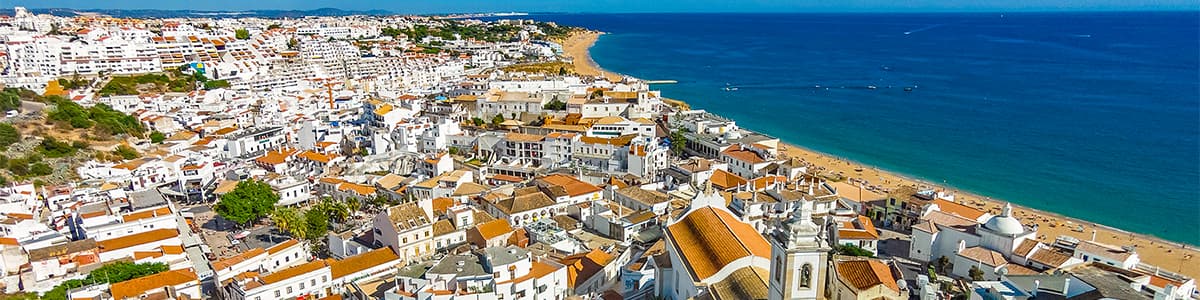
The city of Albufeira maintains a historical and cultural heritage that demonstrates the spirit and strength of a population that believes in the essential power of Faith. There are various physical proofs of this way of life to confirm this.
We highlight below some of the points of interest not to be missed.
|
  |
 |
Torre do Relógio (Clock Tower)
This is the “landmark” of the city. With an iron crown from which are suspended the hourly chimes, it has an excellent panoramic view over the city. |
 |
Torre Sineira (Bell Tower)
Built in 1869, it is part of the Parish Church Edifice and has a belfry with 8 bells. |
 |
Igreja Matriz (Parish Church)
Erected in the Neo-Classic architectural style in the 18th Century, it replaced an earlier church which was demolished in the earthquake of 1755. On the archway over the main door is a Cross of Aviz, symbol of the Religious/Military Order that administered Albufeira. Here we find, among others, a statue from the 18th Century of Our Lady of Conception – the patron saint of Albufeira. |
 |
Capela da Misericórida
(Chapel of Mercy)
This ancient Arab Mosque was transformed onto a chapel in 1499, with some Gothic architectural touches. |
 |
Igreja de Sant'Ana
(Church of St Ann)
This temple was built in the 18th Century. The main nave has a wooden alter piece, possibly by the masters Francisco Xavier Guedelha and João Baptista.. |
 |
Igreja de São Sebastião (Church of St Sebastian)
Built in the mid 18th Century, the exterior is adorned with a dome and two doors in the “Baroque” and “Manuelino” architectural styles.
Today it is a museum for Religious Artefacts and tiled panels and images dating from the 16th and 17th Centuries enhance its interior. |
 |
Ermida de N. ª Senhora da Orada
(Chapel of Our Lady of the Wayside)
The original chapel dates from the 16th Century, but the present one was built in the second half of the 18th Century. It is to be found next to the Albufeira Marina. Every year, on the 13th, 14th and 15th of August, Albufeira celebrates the feast day of Nossa Senhora da Orada, with a procession by land and sea, during which a “Blessing of the Sea” takes place. |
|
Porta de Santana (St Ann's Door)
This was one of the doors into the castle, giving access to a chapel with the same name. Formally the Town Hall, with probable Medieval origin, it was partially destroyed by the earthquake in 1755, but retains its coat of arms of the Azevedo Family, Lord Mayors of the Castle of Albufeira. |
|
 Estátua de São Vicente (Statue of St. Vincent of Albufeira)
This monument is in the memory of Brother Vicente de Stº Antonio, who was born in 1590 in the town of Albufeira. Well educated and intelligent, he left Albufeira to continue his studies in the Capital (Lisbon). He dedicated his life to the church after the death of his parents, and his faith led him to pilgrim to the East, namely Japan. There he suffered persecution by non-believers in Christianity. He died on the 3rd of September 1632, whilst holding a crucifix and crying out “Live the Faith of Jesus Christ!” His Saint’s Day is celebrated every September. |
 |
Old Castle Wall
In the Rua Joaquim Pedro Samora is a small remainder of the wall, possibly where one of the castle wall towers once stood, which was probably the North gate or Beach gate. |
 |
Old Military Battery
This was probably built in the 16th Century on a part of the cliff top that reaches 41 metres high. The collapse of part of the cliff opened a subterranean cave, which was perfect for the storage of munitions |
 |
Arch of the old church street
Of Arab architecture, the arch reveals the existence in this street of an old Arab mosque, later transformed into a Christian church but destroyed in the 1755 earthquake. |
 |
Municipal Museum of Archaeology
On exhibit are items directly connected with the history of the city. |
|
|
|
 |